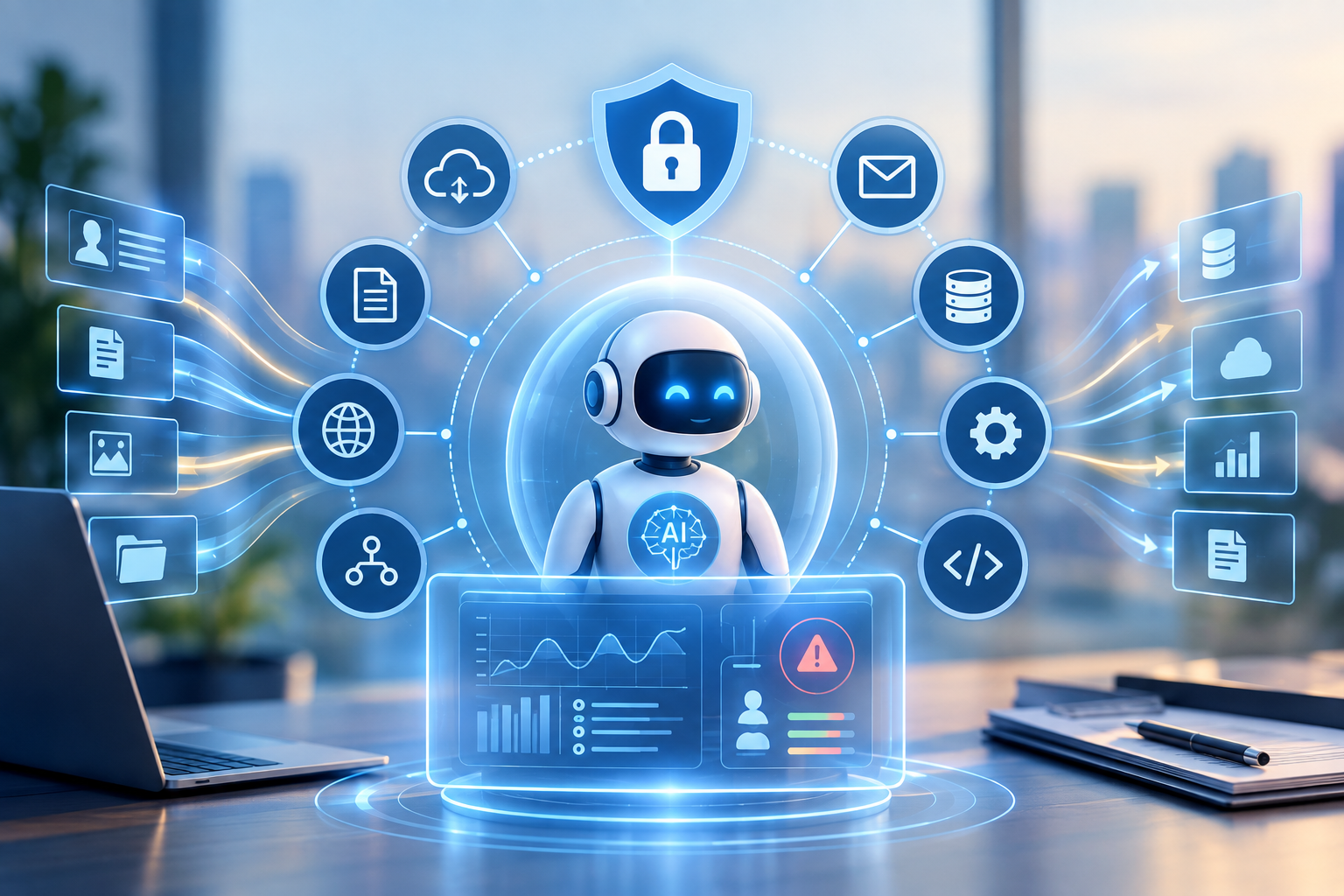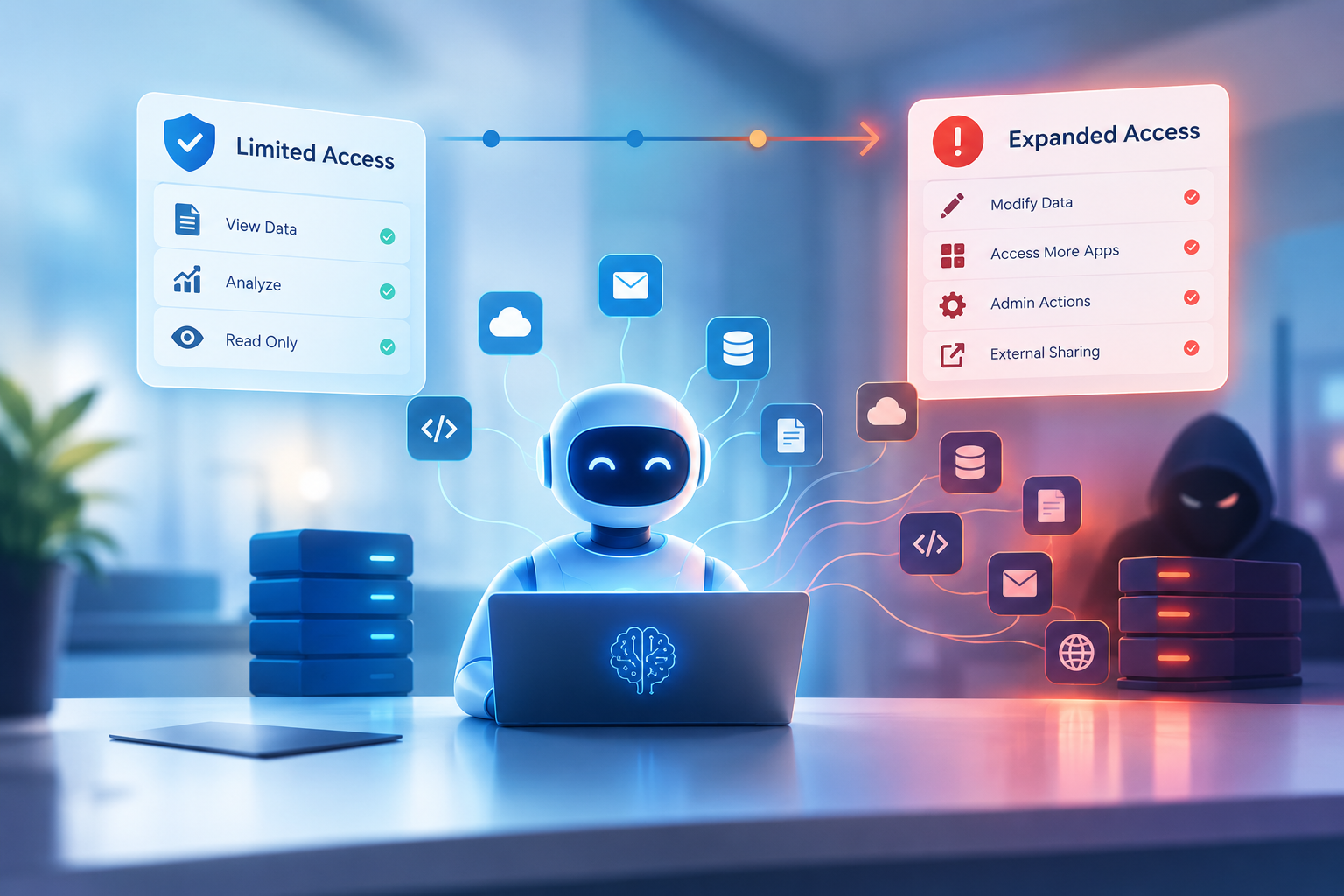


 Trupti ThakurFor years, cybersecurity teams have focused on protecting accounts, applications, APIs, and privileged users. With the rapid adoption of AI-powered assistants and autonomous agents, a new security concern is emerging: the ability for a seemingly harmless prompt to trigger privileged actions. What Are Prompt-to-Privilege Attacks? A Prompt-to-Privilege attack occurs when an attacker manipulates an AI system into using its legitimate permissions to perform an action that the attacker should not be authorized to execute directly. The attacker may not need administrator credentials. Instead, they exploit the AI's instructions, connected tools, excessive permissions, or workflow logic. For example, an AI agent may be authorized to read internal documents, access a ticketing system, query databases, or execute business workflows. A carefully crafted request could attempt to make the agent retrieve restricted information, modify records, or initiate an action beyond the user's intended authority. The security boundary therefore shifts from: “Who has access?” to: “What can the AI do on behalf of someone?” Why This Is Different Traditional privilege escalation generally involves exploiting a vulnerability to obtain higher permissions. Prompt-to-Privilege attacks can take a different path: Prompt → AI interpretation → Tool/API invocation → Privileged action The AI may already possess legitimate permissions. The security problem arises when those permissions are too broad, insufficiently constrained, or incorrectly mapped to the requesting user's authority. This creates a difficult distinction between authentication, authorization, and AI decision-making. Key Risk Areas Organizations integrating AI into business workflows should consider several risks: Excessive AI permissions — AI agents receive more access than necessary. Weak user-to-agent authorization — the AI can perform actions that the requesting user cannot perform directly. Tool abuse — connected APIs or plugins can become pathways to sensitive systems. Instruction manipulation — malicious or untrusted content influences the AI's behavior. Insufficient approval controls — high-impact actions occur without human confirmation. Poor monitoring — organizations cannot determine why an AI agent performed a particular action. How Organizations Can Reduce the Risk Security teams should treat AI agents as privileged digital identities, not simply software assistants. Effective controls can include: Apply least privilege to every AI agent and connected tool. Separate user permissions from agent permissions and enforce authorization at the action level. Require human approval for sensitive or irreversible operations. Implement tool-level controls instead of allowing unrestricted API access. Log prompts, tool calls, decisions, and resulting actions where appropriate. Regularly review AI permissions just as organizations review employee and service-account access. Test AI workflows adversarially to identify privilege-escalation and instruction-manipulation scenarios. Define clear ownership and accountability for every AI-enabled business process. The Bigger Security Question The emergence of Prompt-to-Privilege attacks highlights an important change in enterprise security. An AI system doesn't necessarily need to become privileged to create a privilege-related security incident. It may already have legitimate access—and the real risk comes from how that access is interpreted and exercised. As organizations move from AI assistants toward autonomous agents, prompt security, identity security, authorization, and API security can no longer be treated as completely separate disciplines. The next generation of least-privilege security will therefore need to answer a broader question: Not only “Who can access this system?” but also “What actions can an AI take, for whom, under what conditions, and with what level of authorization?” That may become one of the defining security questions of the AI-driven enterprise.
 #CyberSecurity #AIsecurity #InformationSecurity #DataSecurity #CyberRisk #IAM #ZeroTrust #LeastPrivilege #AIAgents #GenerativeAI #CloudSecurity #APISecurity #CyberAwareness
Prompt-to-privilege Attacks

For years, cybersecurity teams have focused on protecting accounts, applications, APIs, and privileged users. With the rapid adoption of AI-powered assistants and autonomous agents, a new security concern is emerging: the ability for a seemingly harmless prompt to trigger privileged actions. What Are Prompt-to-Privilege Attacks? A Prompt-to-Privilege attack occurs when an attacker manipulates an AI system into using its legitimate permissions to perform an action that the attacker should not be authorized to execute directly. The attacker may not need administrator credentials. Instead, they exploit the AI's instructions, connected tools, excessive permissions, or workflow logic. For example, an AI agent may be authorized to read internal documents, access a ticketing system, query databases, or execute business workflows. A carefully crafted request could attempt to make the agent retrieve restricted information, modify records, or initiate an action beyond the user's intended authority. The security boundary therefore shifts from: “Who has access?” to: “What can the AI do on behalf of someone?” Why This Is Different Traditional privilege escalation generally involves exploiting a vulnerability to obtain higher permissions. Prompt-to-Privilege attacks can take a different path: Prompt → AI interpretation → Tool/API invocation → Privileged action The AI may already possess legitimate permissions. The security problem arises when those permissions are too broad, insufficiently constrained, or incorrectly mapped to the requesting user's authority. This creates a difficult distinction between authentication, authorization, and AI decision-making. Key Risk Areas Organizations integrating AI into business workflows should consider several risks: Excessive AI permissions — AI agents receive more access than necessary. Weak user-to-agent authorization — the AI can perform actions that the requesting user cannot perform directly. Tool abuse — connected APIs or plugins can become pathways to sensitive systems. Instruction manipulation — malicious or untrusted content influences the AI's behavior. Insufficient approval controls — high-impact actions occur without human confirmation. Poor monitoring — organizations cannot determine why an AI agent performed a particular action. How Organizations Can Reduce the Risk Security teams should treat AI agents as privileged digital identities, not simply software assistants. Effective controls can include: Apply least privilege to every AI agent and connected tool. Separate user permissions from agent permissions and enforce authorization at the action level. Require human approval for sensitive or irreversible operations. Implement tool-level controls instead of allowing unrestricted API access. Log prompts, tool calls, decisions, and resulting actions where appropriate. Regularly review AI permissions just as organizations review employee and service-account access. Test AI workflows adversarially to identify privilege-escalation and instruction-manipulation scenarios. Define clear ownership and accountability for every AI-enabled business process. The Bigger Security Question The emergence of Prompt-to-Privilege attacks highlights an important change in enterprise security. An AI system doesn't necessarily need to become privileged to create a privilege-related security incident. It may already have legitimate access—and the real risk comes from how that access is interpreted and exercised. As organizations move from AI assistants toward autonomous agents, prompt security, identity security, authorization, and API security can no longer be treated as completely separate disciplines. The next generation of least-privilege security will therefore need to answer a broader question: Not only “Who can access this system?” but also “What actions can an AI take, for whom, under what conditions, and with what level of authorization?” That may become one of the defining security questions of the AI-driven enterprise.